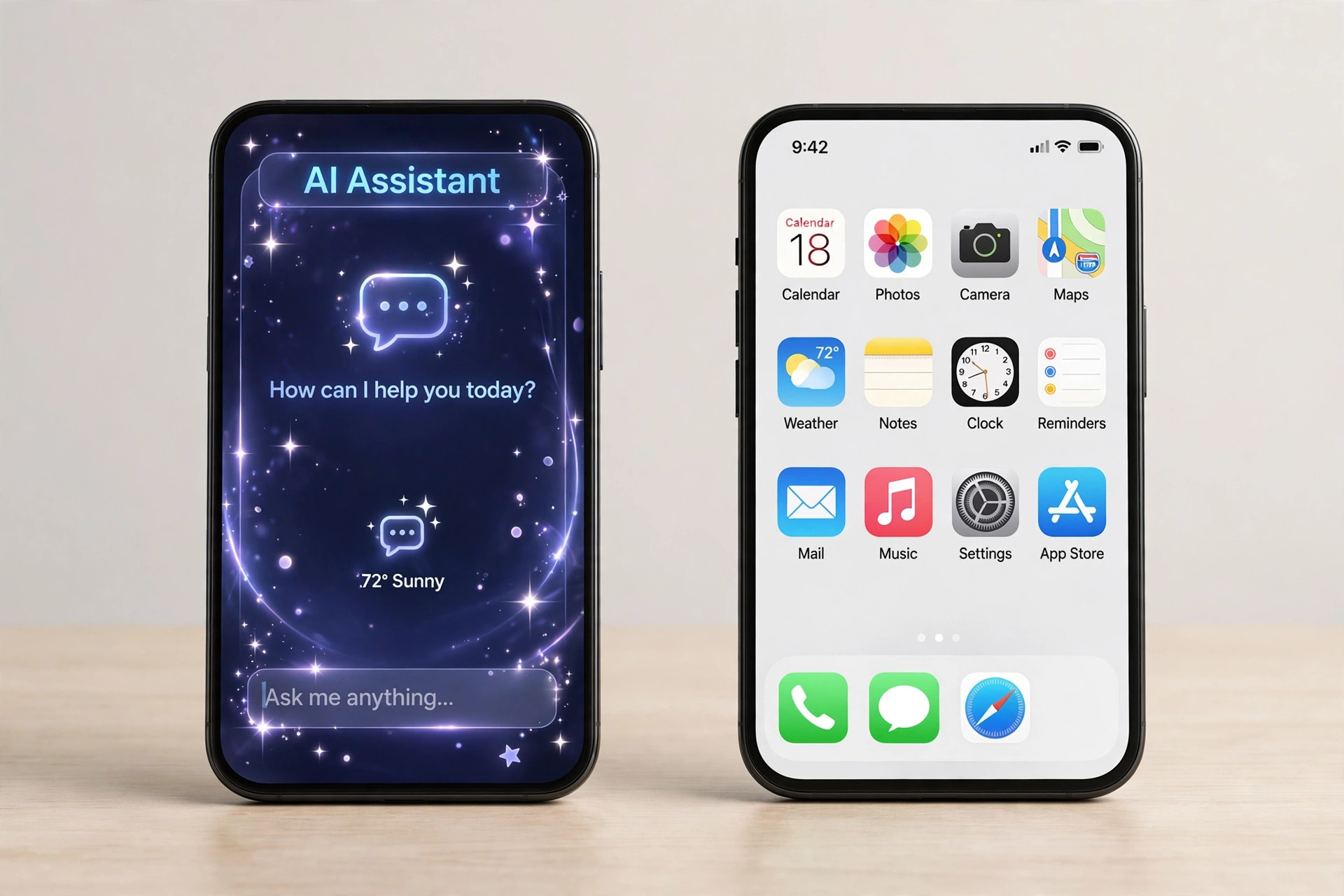
An "AI phone" is a smartphone with a dedicated neural processor (NPU) and system-level AI features — live translation, advanced photo editing, a smarter assistant. Regular smartphones can run AI apps, but AI phones handle demanding AI tasks on the device: faster, more private, and partly usable offline. If you bought a flagship since 2023, you probably already own one.
Stand in any phone shop in 2026 and the word "AI" hits you from every poster. So here's the question nobody answers straight: what's actually different between an AI phone and a regular smartphone? The honest answer is simpler than the marketing — and more useful than the hype.
AI Phone vs Traditional Smartphone: Quick Comparison
| AI Phone | Traditional Smartphone | |
|---|---|---|
| AI chip (NPU) | Yes — dedicated neural processor (~30+ TOPS) | No, or basic AI acceleration only |
| AI processing | On-device: faster, more private | Mostly cloud-based: slower, less private |
| Works offline | Partially — core features work without internet | AI features need a connection |
| Privacy | Data stays on your phone for on-device tasks | Data sent to servers for processing |
| Examples | iPhone 15 Pro+, Pixel 8+, Galaxy S24/S25 | Older flagships, budget phones |
| Price | Flagship prices ($800+) | Full range, from budget up |
| Who it's for | Anyone buying a flagship in 2026 — you get it by default | Anyone happy with a basic or older phone |
Bottom line of the table: the "AI phone" isn't a separate category you shop for — it's what flagships became. The real question is whether you need a new phone at all.
So What Actually Makes a Phone an "AI Phone"?
It's not the apps. It's the chip. An AI phone has a dedicated neural processing unit (NPU) alongside the usual CPU and GPU. Think of it this way: the CPU is the all-rounder worker, the GPU is the graphics artist — and the NPU is the pattern-spotter, a part of the chip built specifically for the math that AI runs on.
Real examples you can buy: Qualcomm's Snapdragon 8 Elite, Apple's Neural Engine (in the iPhone 15 Pro and everything newer), and Google's Tensor G5 in the Pixel 10. Wikipedia puts the rough threshold at around 30 TOPS — 30 trillion AI operations per second — for a phone to count as genuinely AI-capable.
The Numbers Behind the Hype
This isn't a niche trend — it's the whole industry moving at once:
- 364% year-on-year growth in generative-AI smartphone shipments in 2024, reaching 234.2 million units (IDC).
- Over 30% of all smartphones shipped were expected to include generative AI features by the end of 2025 (Deloitte).
- 57% of people say they have privacy concerns about AI in their phones (S&P Global).
- 50% say they won't pay extra for AI features — and only about 1 in 10 would pay for an AI subscription (eMarketer).
That last number is the one the phone makers are quietly worried about. Everyone wants AI on the phone; almost nobody wants a new monthly bill for it.
Do I Already Own an AI Phone?
Probably, yes. Here's the 30-second check. On iPhone: open Settings and look for Apple Intelligence — you need an iPhone 15 Pro or newer. (The Siri AI beta arrived with iOS 27 in September 2026, and Apple's on-device models take up roughly 7 GB, so check your free space.) On Samsung: look for Galaxy AI features — S24 and S25 series qualify. On Pixel: Gemini features, Pixel 8 and newer.
If your phone was a flagship bought in 2023 or later, it almost certainly qualifies. The "AI phone" era snuck in while we were all looking at cameras.
Does an AI Phone Work Offline?
Partially — and this is where the marketing oversells hardest. Some features genuinely run on the device: basic photo edits, some translation, on-device dictation. But the impressive stuff — complex assistant reasoning, generative image tools — still phones home to the cloud. One real-world test found that only 2 of 5 flagship phones worked meaningfully with no Wi-Fi at all.
The practical rule: if a feature needs to "understand" something complex, it probably needs the internet. If it's pattern-matching on your photos or voice, it probably runs locally — worth knowing before you rely on live translation in a foreign subway.
Honest Question: Is "AI Phone" Just Marketing?
Mostly it's a real phone with real system-level AI — but the label is doing a lot of heavy lifting. Analyst Paolo Pescatore put it bluntly: manufacturers are using AI to reignite upgrade cycles because phones themselves "have not been as exciting" lately. And he's not wrong.
Here's my take: the useful features are genuinely useful. Circle to Search — draw a circle around anything on screen to search it — is the kind of thing you use ten times a day once you know it exists. Live Translate on calls is close to magic the first time. But none of this makes it a different kind of device. An AI phone is a smartphone with a better brain, not a new species.
Will AI Features Stay Free?
The uncomfortable question. Remember that eMarketer stat: 50% won't pay extra, and only ~1 in 10 would subscribe. Phone makers know this. My read: the core features will stay free because they sell hardware — Apple and Samsung want you buying the phone, not the subscription. But expect "AI Pro" style premium tiers for the heavy-duty stuff, like video generation. If a feature costs the company real cloud compute every time you use it, a subscription is coming eventually. For a broader look at where AI is heading in daily life, see our guide to AI in everyday life.
The October 2026 Context Nobody Mentions
Two things happening right now will shape AI phones more than any feature launch. First, AI companies — reportedly including OpenAI — are planning their own phones to rival Apple and Samsung (SamMobile, October 2026). Second, and bigger: memory now costs more than the processor in premium phones, making up over 30% of the bill of materials. IDC puts the 2026 average smartphone selling price at $523, up 14%, while Q3 shipments fell 20% year-on-year (Reuters, October 12, 2026). Translation: AI phones are here to stay, but expect to pay more for the hardware that runs them.
The Bottom Line
An AI phone is a regular smartphone with a dedicated AI chip (NPU) and system-level AI features — faster, more private AI that partly works offline. If you own a 2023-or-newer flagship, you're already holding one. If you're buying now, ignore the label and shop the features: which AI tricks would you actually use every week? That's the only difference that matters. For the assistants behind these phones, see our Claude vs ChatGPT guide and 2026 gadgets roundup.
Frequently asked questions
What exactly is an AI phone?
An AI phone is a smartphone with a dedicated neural processor (NPU) and system-level AI features such as live translation, advanced photo editing, and a smarter assistant. The NPU lets demanding AI tasks run directly on the device instead of in the cloud.
What's the difference between an AI phone and a regular smartphone?
Regular smartphones can run AI apps, but they process most AI in the cloud, which is slower and less private. AI phones add a dedicated NPU chip that runs AI tasks on-device — faster, more private, and partly functional without internet.
Do AI phones work without the internet?
Partially. On-device features like basic photo editing and some translation work offline, but the most powerful AI features — complex assistant queries, generative image tools — still need the cloud. One test found only 2 of 5 flagship phones worked meaningfully with no Wi-Fi.
How do I know if my phone is an AI phone?
On iPhone, look for Apple Intelligence in Settings (iPhone 15 Pro or newer). On Samsung, look for Galaxy AI features (S24 and S25 series); on Pixel, Gemini features (Pixel 8 and newer). If your phone was a flagship bought in 2023 or later, it almost certainly qualifies.
Are AI phones worth upgrading to?
If you already own a 2023-or-newer flagship, probably not — you likely have the key AI features already. When buying new, look for the AI features you would genuinely use rather than paying extra just for the "AI phone" label.
Wait — don't upgrade for the label
"AI phone" is real hardware doing genuinely useful things (Circle to Search, live translation), but it's not a new device category — it's what flagships are now. If your phone is from 2023 or newer, you already own one. When you do buy, shop the features you'll actually use weekly, not the AI badge on the box.