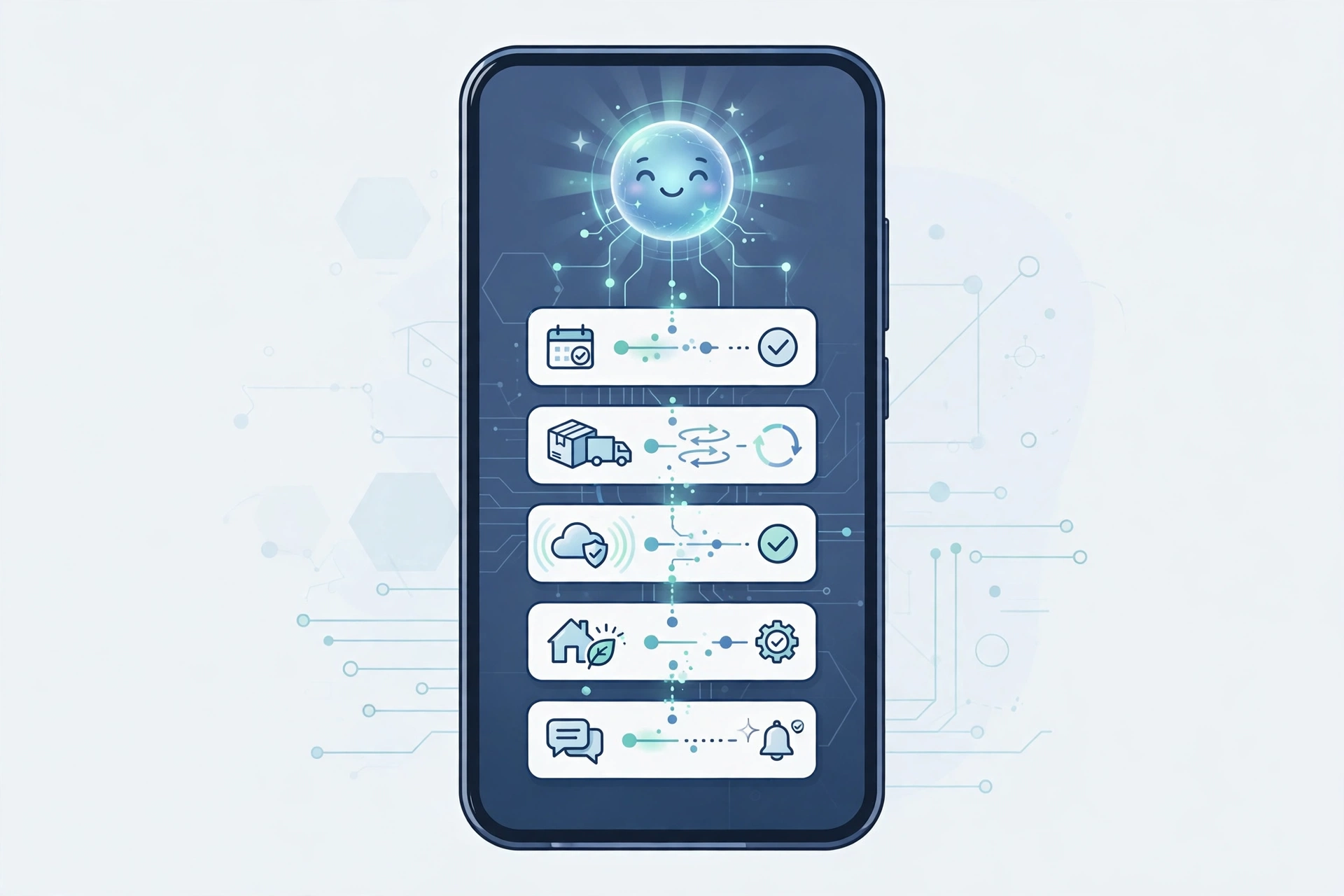
Cyclon is an AI-native phone system from a Y Combinator startup, launched November 3, 2026. Instead of opening apps yourself, you tell its chatbot what you want and AI agents do it across your apps. Pre-orders cost $699, and early buyers get a Pixel 8a running Cyclon within 30 days while the final hardware is built for mid-2027.
On November 3, 2026, a tiny startup launched a phone meant to replace apps, not add more of them. Cyclon, from Y Combinator's F26 batch, turns your phone into a chatbot that books, messages, orders, and organises on your behalf. No home screen full of icons to hunt through — you just say what you want done.
What exactly is the Cyclon AI phone?
The Cyclon AI phone is a phone built around an AI agent instead of an app grid. You describe the outcome you want — "book me a taxi for 6pm", "reply to Sarah and reschedule to Thursday" — and its agents operate your existing apps to make it happen, or build a small tool on the spot when no app fits. The idea is that you stop managing apps and start managing outcomes.
That puts it in the same wave as the agentic phones coming out of China — ZTE's Nubia Navix Ultra, which runs ByteDance's Doubao agent and drops the conventional home screen, and Honor's YOYO agent across MagicOS 10 devices. The difference: Cyclon targets US buyers, while those devices have no US launch planned.
How does it actually work?
Cyclon works by giving AI agents permission to drive your phone. You issue a request in plain language, the agent breaks it into steps, and it carries those steps out across apps — reading notifications, drafting replies, filling forms, placing orders — reporting back when it is done or when it needs a decision only you can make. It can also generate a small app on demand for a one-off job, rather than making you install something you will use twice and forget.
Here is the honest part: this only works as well as the agents' judgment. An agent that can message your contacts and spend your money is enormously convenient right up until it misunderstands you. The early demos all show simple, well-defined tasks; messy real-world jobs — three competing constraints and a human on the other end — are where these systems still stumble, and Cyclon has not yet shown it can handle those.
What does the $699 pre-order get you?
Pre-ordering Cyclon costs $699 for the final custom phone, which is expected to ship in the second quarter of 2027 — a date the company itself presents as a projection, not a guarantee. While you wait, the first batch ships you a Google Pixel 8a with Cyclon's software preinstalled, within 30 days of your pre-order, so you can use the system now on borrowed hardware.
That two-phone deal is clever and a little telling: Cyclon knows its software is the product and its hardware is not ready. You are buying into the agent platform, with a phone attached later. If you like being first, that is a fair trade; if you want a finished product, wait for the hardware reviews.
Why are AI phones suddenly everywhere?
AI phones are having a moment because the app model is straining. Ericsson ConsumerLab's September 2026 report, covering over 43,000 users in 27 markets, found only about 4% of smartphone users already use agentic AI tools — but 38% expect to by 2030. Counterpoint forecasts GenAI-capable phones at 45% of 2026 shipments, up from 36% in 2025. Apple and Google are cramming AI into app-centric phones, while startups like Cyclon and China's handset makers bet the agent replaces the app layer entirely.
My read? Both things are true at once. Agentic phones are the most interesting idea in smartphones in a decade, and Cyclon is a first-generation product from a young startup. Those two facts should live side by side in your head before you spend $699.
Should you buy a Cyclon phone?
If you are an early adopter who enjoys unfinished technology and can afford for it to disappoint, yes — the Pixel 8a prototype means you are not waiting a year to try the idea, and $699 matches a mid-range flagship. If your phone is a tool you depend on daily, wait. Let the first batch shake out the reliability problems, the privacy questions (an agent that reads your messages needs serious safeguards), and whether people actually want AI handling every interaction. For most readers, watch the first reviews in early 2027 and decide then.
For context on the wider shift, see our guide to whether an AI phone is worth buying and our comparison of AI phones versus regular smartphones.
Frequently asked questions
What is the Cyclon AI phone?
It is an AI-native phone system from Y Combinator startup Cyclon that replaces the app grid with a chatbot and AI agents that carry out tasks across your apps, or build small tools on demand.
How much does the Cyclon phone cost?
Pre-orders cost $699 for the final custom phone. Early buyers also receive a Pixel 8a prototype running Cyclon software within 30 days of pre-ordering.
When does the Cyclon phone ship?
The Pixel 8a prototype ships within 30 days of pre-order. The final custom Cyclon hardware is expected in the second quarter of 2027, though that date is a projection, not a firm commitment.
Is Cyclon a replacement for iPhone or Android?
Not yet. The first version runs on a repurposed Pixel 8a — Android underneath, Cyclon's agent layer on top. A new way of using a phone, not a new phone platform, at least for now.