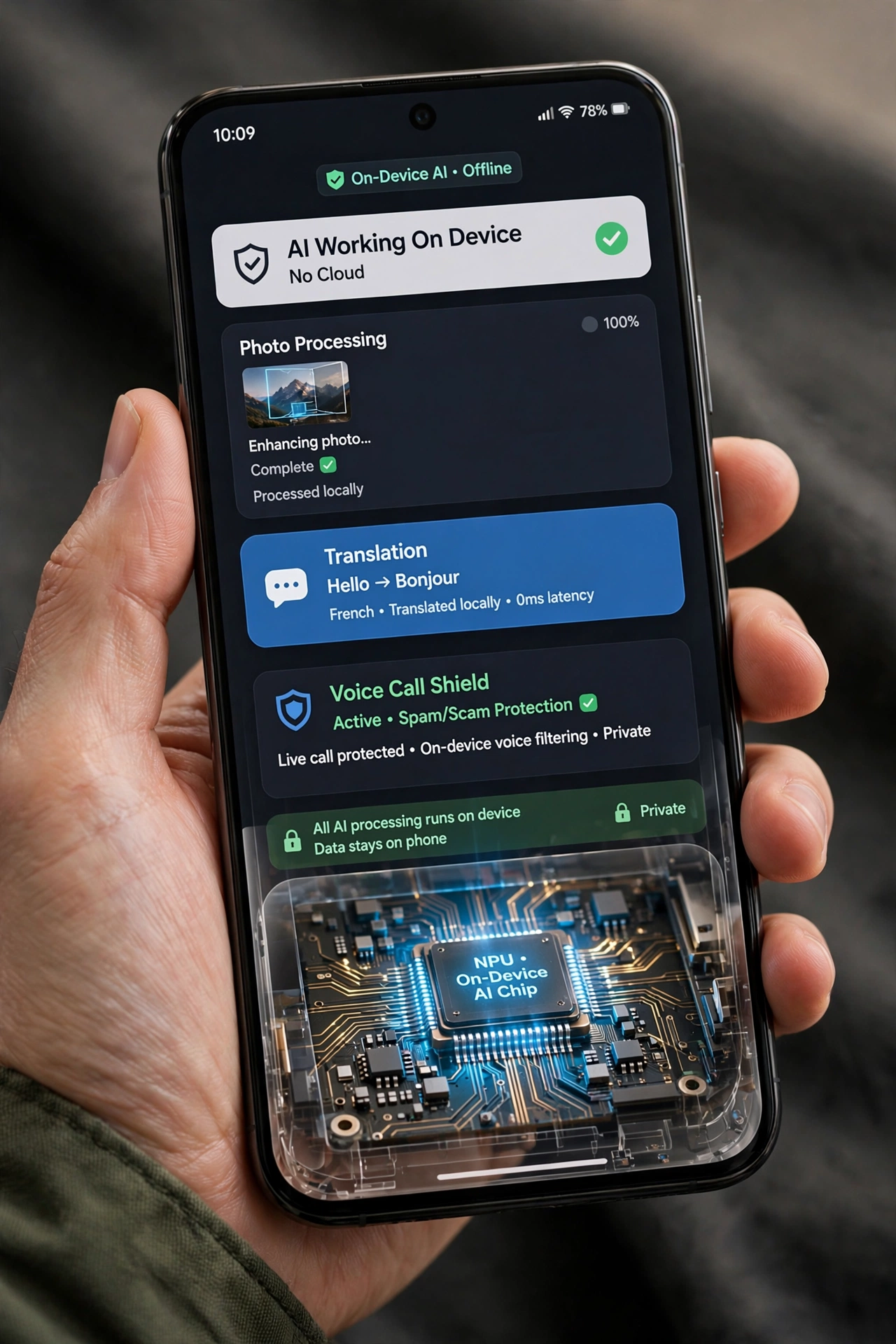
An AI phone is a phone with a dedicated AI chip that runs smart features on the device itself — better photos, live translation, and scam-call screening — without sending everything to the cloud. Worth buying in 2026 if you need a new phone anyway; not worth an early upgrade just for the label.
Walk into a phone shop in late 2026 and every poster shouts AI. It's easy to assume that means a chatbot glued onto your home screen. Honestly, that's the least interesting part. The real change is quieter: the chip inside your phone can now do serious thinking on its own.
What Is an AI Phone, Exactly?
An AI phone is a smartphone with a dedicated neural processing unit, or NPU — a small part of the chip built only for AI maths — that runs AI features directly on the phone. A normal processor can run AI too, but slowly and with more battery drain; an NPU does the same work faster and cheaper, which is why these features suddenly feel instant.
Don't confuse an AI phone with a phone that merely has an AI app. Open ChatGPT on a five-year-old phone and every answer still travels to a server and back. On a true AI phone, much of the work never leaves your hand — which matters for speed, privacy, and patchy signal. See our AI phone vs smartphone explainer for more.
How Does On-Device AI Actually Work?
On-device AI means a smaller, specialised model lives on the phone and runs on the NPU, while the giant models still live in the cloud. Think of it as a pocket calculator versus calling a mathematician: the calculator handles everyday sums instantly, and you only ring the expert for the hard stuff.
The Pixel 11 shows what this looks like in practice. Its Tensor G6 chip runs Magic Capture entirely on the phone; PetaPixel's Pixel 11 Pro review, quoted by TalkAndroid, measured that pipeline at under 400 milliseconds in daylight. Google claims the G6's AI cores are roughly 40% more power-efficient per inference than the G5, per the same breakdown.
What Can an AI Phone Actually Do for You?
Forget the demos for a minute. Here is what on-device AI does on a normal Tuesday, and this is where it earns its keep:
- Photos that fix themselves. The phone blends several frames, separates you from the background, and balances light before you lower the phone.
- Live translation in conversation. Speak, and the phone translates out loud in near real time — handy abroad, and it works where Wi-Fi doesn't.
- Calls screened before you answer. On-device scam detection spots fraud-call patterns and warns you, covered separately in our scam-call protection guide.
- Smarter typing and summaries. Predictive text, call transcripts, and notification summaries that don't need to phone home first.
The pattern is simple: private tasks — your face, voice, messages — are faster and more private on the phone; tasks needing the whole internet still belong in the cloud.
Is an AI Phone Worth Buying in 2026?
Yes, with one condition: buy one if you were already buying a phone, not because the box says AI. Most 2026 flagships from Google and Samsung include on-device AI as standard, so you get it without paying a separate AI premium. That's the sweet spot.
Here's my honest call. If your current phone is two or three years old and the battery is fading, a 2026 AI phone is a genuinely good upgrade — the camera alone will feel like a jump. If your phone still does everything you need, don't rush out for the label; the features will only get better, and right now they are conveniences, not reasons to break a working contract. Memory prices are also pushing phone prices up, as we explained in our guide to why phone prices are rising in 2026, so an early upgrade can cost more than the AI is worth to you.
One thing to watch: Qualcomm chief executive Cristiano Amon told MacObserver in October 2026 that leading AI companies want phones able to run at least a 100-billion-parameter model locally, all the time, by 2028. Today's phones are nowhere near that — so buy for what the phone does now, not for a 2028 promise.
What Should You Check Before You Buy?
Before you pay, check four things and ignore the rest of the marketing. First, which features run on-device and which need the cloud — the box rarely says, so check the manufacturer's feature page. Second, whether the features you care about work in your language and region, since translation and call screening roll out unevenly. Third, battery life in real reviews, not just the headline number. And fourth, how long the phone will get software updates — an AI phone that stops getting model updates in two years ages fast.
Frequently asked questions
What is an AI phone?
An AI phone is a smartphone with a dedicated AI chip, called a neural processing unit, that runs AI features directly on the device — photo editing, live translation, and call screening — instead of sending everything to a cloud server.
Do AI phones work without internet?
On-device AI features, such as photo processing and live translation on the latest Pixel and Galaxy phones, work without a connection. Chatbot-style features that need a large model still need the internet.
Is an AI phone worth buying in 2026?
Yes, if you were already buying a new phone — most 2026 flagships include on-device AI at no extra charge. It is not worth upgrading early or paying a premium just for the AI label alone.
Is on-device AI more private than cloud AI?
Generally, yes. When processing happens on the phone, your photos, calls, and voice do not have to leave the device for that task. Cloud features still send data to a server, so check which features are on-device before assuming.
Sources: TalkAndroid's Pixel 11 on-device camera breakdown and MacObserver's report on AI companies planning their own phones.