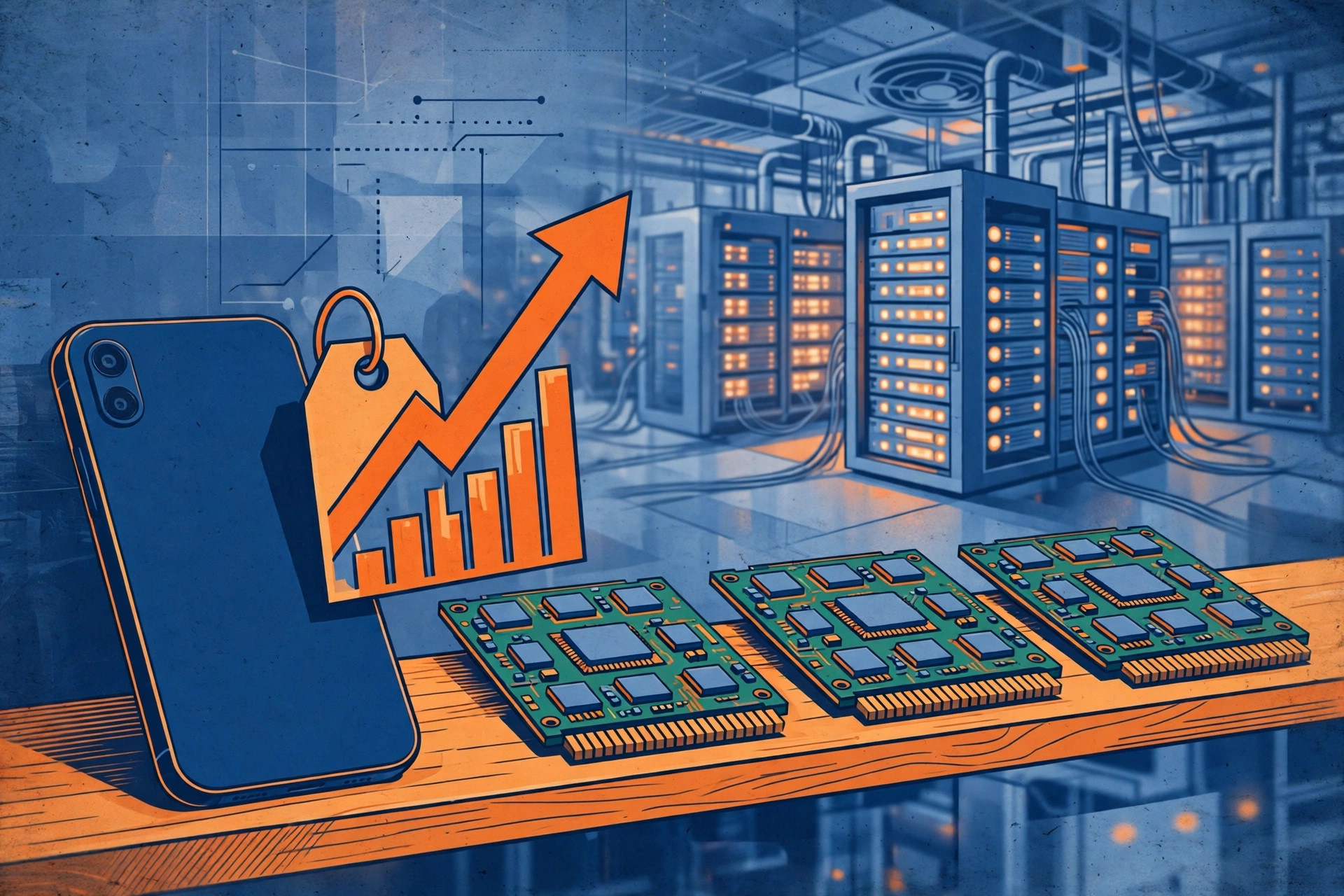
Phone prices are rising in 2026 mainly because memory chips got dramatically more expensive. AI data centres are buying up DRAM and NAND flash production, so phone makers pay far more for the same chips — and that cost lands on buyers, hardest on budget phones. Waiting for a quick price drop is probably wishful thinking.
What is actually happening to phone prices?
Here's the short version: phones are selling less and costing more. An IDC 2026 forecast summarised by PBX Science puts global shipments down 16.7% to just over 1 billion units, while the average selling price rises 27.6% to $581 — the signature of a supply problem, not a demand boom.
The rises are not subtle. Reporting in October 2026 noted Google adding $100 across the Pixel 11 lineup, with the budget Pixel 10a jumping from $499 to $599, and Samsung raising Galaxy S26 prices after launch. Google's devices chief, Shakil Barkat, told 9to5Google the hikes were forced by a severe memory crisis, citing Morgan Stanley data that put 1GB of RAM at $2.80 in 2025 and $12 now.
So what is the RAM shortage, exactly?
Two kinds of memory go into your phone, and both are caught in the same squeeze. DRAM is the working memory — the RAM holding your open apps. NAND flash is the storage — your photos, apps and files. Both are made by a tiny club: Samsung, SK Hynix and Micron make more than 90% of the world's DRAM.
And shift they have. The same factory capacity that makes phone memory can be pointed at high-bandwidth memory (HBM) for AI servers, which sells for far more per gigabyte. So lines move toward server memory, phone-grade supply tightens, and prices climb. Counterpoint Research estimates smartphone memory prices jumped more than 80% quarter on quarter in the second quarter of 2026, and that DRAM plus NAND together rose from about 13% of a typical phone's build cost in early 2025 to roughly 43% by the third quarter of 2026, as reported by PBX Science.
Why do budget phones get hit hardest?
Budget phones have the thinnest margins in the business, so there is nowhere for a cost spike to hide. On a $900 flagship, a $60 memory increase can be swallowed or softened with financing; on a $180 phone, it is a third of the price.
That is why the cheapest phones are disappearing, getting worse specs, or jumping most in price — CCS Insight reporting from June 2026 found some entry-level phones already more than 50% pricier than a year earlier.
It also explains a story doing the rounds this week: a tipster claim, reported by Gadgets360 on 28 October 2026, that 16GB RAM variants could disappear in 2026, with makers reviving 4GB models. Treat that as a rumour, not a confirmed plan.
Should you buy now, or wait?
If your phone is dying — battery gone, screen cracked, apps crashing — buy now. Analysts quoted in October 2026 reporting expect the shortage to run into 2027, so waiting may just mean buying the same phone later at the same price or higher.
If your phone still does its job, keep it another year; a battery replacement costs a fraction of a new phone. If you do buy, prioritise RAM over storage and aim for 8GB as the floor — our 8GB RAM guide makes the same case for laptops. Buy the previous generation's flagship over this year's mid-ranger if the prices meet, and check the refurbished market.
Is 4GB of RAM enough in 2026?
For calls, messaging and light browsing, yes, it works. For everything else — maps plus music plus a browser with ten tabs, a banking app that must not reload mid-payment — 4GB feels tight from day one and gets worse as apps grow heavier.
If you are choosing between a 4GB model and an 8GB model at a modest price gap, pay the gap. Before you hand over money, free up the phone you already own: clearing caches and trimming message attachments often makes an "old, slow" phone feel new — see our iPhone storage guide.
When comparing phones, check RAM before camera megapixels. RAM decides whether the phone still feels fast in year three.
The bottom line
Phone prices are not rising because phones got dramatically better this year. They are rising because the memory inside them got dramatically more expensive, and AI data centres are outbidding phone makers for the factories that make it. Budget buyers feel it most.
Flagship buyers feel it least. Buy when you must, buy RAM over megapixels, and when you can, keep the phone you already have. See also our gadgets worth buying in 2026 and AI phone vs smartphone explainer.
Frequently asked questions
Why are phone prices rising in 2026?
Mainly because memory chips have become far more expensive as AI data centres buy up the same production capacity, and makers pass that cost on — especially on cheaper phones.
Should I buy a phone now or wait?
If you need one now, buy it — analysts expect the shortage to run into 2027. If your current phone still works well, keeping it another year is the cheapest move.
Is 4GB of RAM enough in a phone in 2026?
For basic calls and light browsing it works, but it feels tight with several apps open and is a poor choice for a phone you plan to keep for years. Aim for 8GB.
Will phone prices come back down?
Probably not quickly. Scarcity is expected to persist through 2027, so prices may stabilise rather than return to 2025 levels soon.
Sources: PBX Science, Gadgets360. Figures are reported estimates.